
The Smell Of A Life Lived
People always ask what it was like to grow up the way I did. My Australian friends shake their heads and usually land on "Well, you turned out alright." Maybe. But when I close my eyes and try to find my way back to childhood, it's not images that come first. It's smells. The damp chill of winter mornings, cigarette smoke threaded through every curtain, every coat and every jersey. The faint, sweet ghost of violet perfume drifting out from under my bedroom door.
Home was the village. Home was also Number 19, The Crescent, Cummersdale, in north west England – a council house at the end of a cul-de-sac that backed onto fields. From the outside it was ordinary and modest. But inside, it was a whole world of sensation.
In the North, the word you used for your mother said everything. In the council houses, it was Mam, Ma or Mother. In the private houses, it was Mum. I never called my Mam anything other than Mam. That single vowel carried a quiet but unmistakable line of class.
The cold that got into everything
The house was always very, very cold in the winter. We had one electric heater in the living room. It was a two-bar Berry Magicoal fire with those funny little whirling metal pieces inside that made the plastic coals glow as if they were on fire. Pretty much everyone in a council house had one; it wasn’t odd. It sat in the old fire grate, standing in for the coal fires people had stopped bothering with. But it was never quite enough.
You went to bed with a hot water bottle. There’d be four or five heavy blankets on top of you, and you’d lie there underneath them like a pressed flower, waiting to warm up. The bathroom was the coldest room in the whole house. We had an immersion heater that lived in my brothers’ bedroom, turned on every Sunday night for bath night. That was our one bath a week and, if anyone forgot to switch it off after an hour, my brothers’ room would grow steamy, with wallpaper peeling away from the walls in soft curls. Sunday bath night did have one saving grace for me: I was the only girl, so I always got in first. My two brothers, Sean and Andrew (also lovingly known as Fatty) went in after. And my grandma used to buy a bottle of Matey bubble bath – the one shaped like a sailor, with a hat that unscrewed as the cap. That was such a treat. It was the kind of small luxury my gran quietly provided, because my mam and dad were pretty poor, and she knew it. Gran also bought Vosene medicated shampoo; I can almost smell it now, sharp and medicinal and completely wonderful.
On every other night, we washed our faces in icy cold water. I can still feel the sting of it on my skin, the shock of it in my mouth when I brushed my teeth. My teeth and stomach have been sensitive to cold water ever since. Some things just stay in the body long after you’ve left the place.
A myriad of smells
The house smelled of cigarettes. My mam and dad were young party people in the late 1960s, drinking too much, smoking like chimneys, barely out of their teens. My mam was sixteen when they married. By the time she was nineteen and a half, she’d had three children. It was cigarettes on the furniture, cigarettes in the hallway, cigarettes in the curtains, even cigarettes in their bedroom. You got used to it. You had no choice.
And then there was the kitchen smell. Boiled cabbage, cauliflower, turnips and potatoes from the land settlements down the road. My friend Elaine, who lived four doors down, and I would go down there together, swinging her mam’s PVC shopping bag between us – a proper 1960s thing – and come back laden with whatever was growing. The kitchen in winter was steamy, the windows fogged, smelling of root vegetables and chips. Always chips. Chips for lunch, chips for dinner, chip butties and the sharp smell of vinegar lingering in the air. To this day I cannot bear the smell of vinegar. I gag and often have to leave the room.
Outside was a whole other story. We lived right on the greenbelt, the fields just over the back fence. There was a pig farm in the village, so there was always that thick, earthy, animal smell. Not charming, not romantic, just ever-present. But in summer, the wheat fields behind the house ripened in the heat and when you walked out the back door, you’d catch it. That warm, golden, grain smell mingling with everything else. Pig farm and wheat fields. That was home.
A little oasis of prettiness
When I wasn’t out playing, I was in my bedroom. Pink and lilac paisley wallpaper, Betsy Clark posters of that sweet American girl with the huge eyes and my own coloured-pencil drawings of wildflowers pinned to the wall. Little porcelain knickknacks, miniature crisp packets I’d shrunk under the grill and blue-tacked to the wardrobe door and sixpences saved in a row for their prettiness.
And the perfume. Little white glass bottles with hand-painted violets on them, bought – and, I’ll be honest, mostly stolen – from the gift shop at Butlins holiday camp. I would have been nine or ten; my friend Angela was a couple of years older and more daring and I followed her lead without a second thought. Those little bottles scented my whole room. Sweet English violet, probably artificial, definitely cheap … but to me, intoxicating. I’d also been given quite pungent pot pourri by my grandma. That room was heavily fragranced by any measure, a deliberate act of escape from the cigarette smoke below. It was my sanctuary from the chaos of the house.
Eight doors down
My real sanctuary was eight doors down The Crescent, at my grandma’s. While everyone else had ripped out their coal fires and stuck electric heaters in the grate, she kept hers. A proper coal fire. I used to love being sent to the coal house for a shovel-full, watching her stack the coal and sticks and crumpled newspaper, and then holding a sheet of broadsheet over the fireguard to starve it of air until it caught. When she told me to, I’d whip the paper away and the flames would leap up, orange and alive.
She always had something baking. Fairy buns, rock buns, an iced orange sponge cake. A biscuit barrel always full. Grandma would peel an orange for me because I hated getting the rind under my nails, then she’d toss the peel into the fire; the smell of orange rind burning on hot coals was something extraordinary. Something I have never quite smelled again.
She also came home from town on Saturdays with treats tucked in her bag. Little glass jars of fish paste to put between two slices of Sunblest white sliced loaf with margarine. That was luxury. You couldn’t be fussy where I grew up; there was no other choice and no point pretending otherwise. But those little jars felt like something special, and my brothers could wipe out a sliced loaf in a day, especially in the school holidays, so they never lasted long. At Christmas, if we were really lucky, there’d be a tin of salmon. Gran was quietly keeping us fed in ways I didn’t fully understand at the time, her pantry was full of baked treats and there was often a tattie-pot warming in the oven. My dad gambled whatever money he had on horses or spent it down the pub. Gran just got on with the job of feeding us whenever she could.
Gran and I’d sit together on the little one-and-a-half-seater sofa in front of the fire, drinking big mugs of tea, sometimes talking, sometimes not. She’d read her People’s Friend magazine. I’d pull out the old black-and-white photographs from her sideboard – sepia prints from the 1940s, men in uniform with inscriptions in dried-out fountain pen. “All my love, Frank.” “Love, Harry.” I’d ask who they all were, and she’d call me her “nosy little bitch” with pure affection, and then she’d tell me. I’d settle into the couch to listen. Stories about the war. She and her friend Peggy used a dark eyebrow pencil to draw a fine seam down the back of each other’s legs, creating the illusion of silk stockings, then riding a horse and cart three miles to the next village for a Saturday night dance. I could have listened for hours. I did listen for hours.
Freedom and the smell of cut grass
Out on The Crescent, everybody knew everybody. Twenty-six houses, all interconnected lives. You didn’t knock. You came in the back door, filled the kettle, turned on the gas on your way through and plonked yourself down in the living room. When the kettle whistled, you made tea for whoever was there. Our house was like that, always full and always slightly chaotic. My dad, when he was still around, ruled the roost in the way men did then: if he came home from the pub and you were watching the midday movie, the channel changed to sport without a word. You left the room, or you kept quiet. There are dozens of classic films I’ve only seen the first half of and nothing more.
There was another sanctuary, though, beyond my grandma’s. My friend Elaine’s house at Number 15. Her mam Christine was like a second mother to me, though I didn’t fully register it at the time. She had four girls and a boy and the place was chaos, but I could walk in, make a cup of tea, sit down among them all and feel completely at home. Nobody ever said anything about the crazy stuff going on in my house. I was just always welcome. When my dad had been drinking and came up to bash the back door in, one of us would slip out the front and run to Christine’s to use the phone. They were one of the few families on The Crescent who had one. Most people had to go to the village telephone box and feed twopenny pieces in. About five minutes after Christine made the call, you’d see Mr Coughlin, the local policeman (also known as the local Bobby), coming up the road end in his little panda car, driving into the cul-de-sac, getting out quietly and going in to remove my dad from the premises. I’d watch from my friend’s bedroom window. Christine and Harold never judged, never gossiped, never said a word to us kids about what they knew of adult life. That was its own kind of grace.
After school, if my Mam’s friends were in the living room we were told not to sit “clocking” – hovering around adult conversations. We were sent outside. And that, honestly, was a gift. We’d be out till dark, which in summer meant ten at night. We ran through fields, played in the woods, foraged around in the seasons: spring mud and blossom, summer wheat and cut grass, autumn leaves and damp earth, winter frost on bare branches. Nobody worried. Nobody tracked us. The world was not yet a place of fear for children and we moved through it like small, free animals.
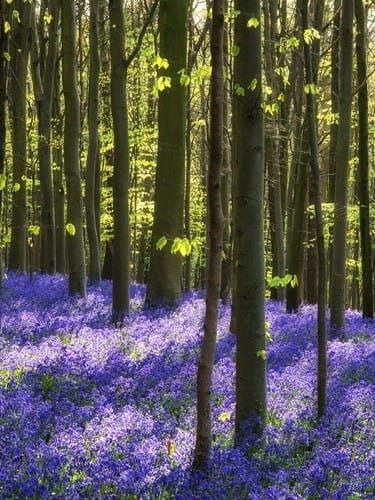
When you got down into the valley, into the woods by the river, the pig farm smell finally lifted. The air changed entirely: cool, green, mossy, alive and, in spring, carpeted in bluebells. The sound of the river in the distance. That was where you could breathe.
What stayed with me
When I came to Australia in 1982, the seasons seemed to disappear. The smells I’d tracked my whole childhood, those four reliable rhythms of the English countryside, weren’t there in the same way. And I realised how much of myself had been oriented by them. How much I’d been a creature of cold and damp and coal smoke and wheat fields.
The smell of Vosene medicated shampoo. Matey bubble bath in a sailor bottle. The singe of a fibre catching on the electric bars of the Magicoal heater. Orange rind on a coal fire. Violet perfume in white glass bottles, hand-painted and half of them stolen. My grandma’s always-clean house, her hairnet and her curlers, her apron and her coal fire and her sideboard cupboard full of photographs of men who’d once loved her. Pig muck and wheat grain.
The feeling in the village, if I had to put it plainly, was freedom. When I close my eyes and I'm back there, little and unselfconscious and alive to everything, what I smell is coal smoke and orange rind. What I feel is warm.

New essays arrive by email. No frequency promises, only when there's something worth saying.

Member discussion