
The Women Who Raised me
They say it takes a village to raise a child. In my case, it literally did. And for a long time, most of my life really, I didn’t fully understand what that meant. I knew the village. I knew The Crescent. I knew which back doors were always unlocked, which kettles were always on. What I didn’t know, not yet, was how much I was being shaped by the women behind those doors. How much I was being quietly, steadily saved.
Under my own roof, at Number 19, there was chaos. It often felt like a circus where emotions ran high and rules were there to be broken. There was little expectation placed on me beyond not following my brothers into trouble. As I approached sixteen, the normal school leaving age back then, the assumption was simple: the chocolate factory or the biscuit factory, like everyone else. That was the plan. That was the ceiling. Nobody said it out loud, but it was there in every look, every comment, every “remember your place, don’t go getting ideas above your station, I don’t know who you think you are”. I was to stay in my box.
What I didn’t know then was that the village itself was quietly refusing to let that happen.
Christine
Christine Beaty lived at Number 15, just along The Crescent from us. She had four girls and a much younger boy, Stephen, and the house was at times absolute bedlam as we’d say in Cumbria, but of the very best kind. Every surface was covered. The living room table was stacked high with washing, sheets, nappies, towels. There were knick-knacks everywhere. The kitchen was next level, permanently in motion, always producing food for the seven hungry mouths and those who passed through. Her husband Harold was a milkman with a cute little electric cart stacked high with crates of clinking glass bottles, and he also knew how to cook, a rarity back then. Christine ran the show from that chaotic kitchen with a pressure cooker that scared the life out of me every time it went off.
The back door was always unlocked. That was just how it was. I’d walk in, put the kettle on, stand and have a chat, wedge myself onto the couch with everyone else. She knew exactly what was going on at Number 19. She knew about the violence, the comings and goings. She was one of the only people on The Crescent with a telephone and one of the very few you could trust not to gossip. When the police needed to be called, it was Christine’s phone we used. I’d slip out the front door, run up to hers and a few minutes later I’d watch Mr Coughlin, the local policeman, drive into our cul-de-sac to remove my dad from the premises. Christine never said a word about any of it. Not a comment, not a look, not a single moment of judgement. She was just providing a safe haven. That’s all. As if it were nothing.
And here’s the thing about that England, that era, those people: nobody hugged anybody. You didn’t show physical affection. You didn’t say “I love you.” Not to your friends, not even to your own family. My gran never hugged me. Nobody told me they loved me. That was just England in those times … Don’t hug me, I’m British. And yet Christine, without a single touch or spoken word of warmth, made me feel completely cared for. There was an ease under her roof. A kindness. A generosity of spirit I had no language for at the time but absorbed through every visit, every cup of tea made in her kitchen, every hour spent squashed on her couch.
I didn’t understand the full weight of what she’d given me until the day she died. I was at my holistic skin clinic in Sydney’s Double Bay. The year was 2005. Elaine, her oldest daughter rang, and I knew before she said it. The impact was immediate, visceral – everything inside me started to implode. I sobbed and sobbed, crumpled in a chair, unable to stand up. I had to call all my clients and cancel. I locked the clinic and walked to the water instinctively, sat on a bench in the sheltered quiet of Double Bay and just stared out at the harbour, going in and out of tears.
An older friend happened to walk past. He sat down and asked gentle questions, and it was then that the penny dropped. A woman who was not my blood mother was, in every way that mattered, one of my true mothers. When I realised that, I was flooded with gratitude. Somebody else’s mum had made me feel whole. That’s the only word for it: whole. Accepted and whole, every time I walked through that back door.
Gran
My gran was the other anchor. She lived eight doors down at Number 11 –close enough to run to, far enough to feel like a different world. Where Christine’s house was chaos and clutter and noise, my gran’s was orderly, quiet and spotlessly clean. She was always in her apron, hairnet on, a couple of curlers at the front that sometimes I felt she never took out. She scrubbed her front doorstep. She beat the rugs on the washing line. She had a coal fire when everyone else had long since switched to electric and I loved helping her lay it. Once laid and comfortably settled in with mugs of tea, she’d often oblige me with a rendition of the heart-wrenching “You are my sunshine”.
She was bothered with her nerves, as people said back then. What they meant was depression and anxiety. I understood that only decades later. She had so much to carry: my mother and father and brothers, her small pension stretched to quietly feed us when my dad had gambled the money away or drunk it. She broke out in psoriasis when the stress got too much. But when she wasn’t having one of those turns, her house was the calmest place I knew.
She gave me space to think. Space to be quiet. Space to be myself in a way that wasn’t available at home. And she gave me the small, steady proof that someone was watching out for me and my brothers. The Tattie Pot - a very Cumbrian hearty meal - was always warming in the oven, even though she herself never ate it. The pantry was full of baked treats, the floor lined with brightly coloured bottles of pop (aka soft drink). The Matey bubble bath she dropped down to No. 19 for Sunday bath night, the little jars of fish paste, the Robertson’s strawberry jam, the occasional tin of salmon at Christmas. She never made a thing of it. She just dropped off food when her pension stretched to it.
Mrs Ballantyne
Mrs Ballantyne was unusual. She lived in one of the private houses on the way down to the mill, which in village terms meant “not usually for the likes of me” to enter. But there was no snobbery, no sense of looking down. She was warm and down to earth and mixed with everybody, and I was fascinated by her house from the moment I first stepped inside.
She had William Morris wallpaper on the walls. I didn’t know it was William Morris until art college, but I knew it was different, rich and patterned and beautiful in a way nothing else in my life was. Old velvety sofas, dark panelling, books everywhere. First time I ever saw a fresh nutmeg and alongside it a little grater. First time I ever tasted raw capsicum and runner beans. She grew things in her garden that I’d either never seen before or never tasted. A visit to Mrs Ballantyne’s was a deeply sensorial experience.
I think she was a frustrated academic, self-educated or perhaps university-educated before marriage shut that door, as it did for so many women of her generation. She ended up going to work at Nestlé’s chocolate factory with my mother and a few other women in the village, just to have her own money, her own freedom. She organised village fetes and festivals, amateur dramatics, all kinds of things that pulled the community together. She was what happened when a brilliant woman had nowhere official to put her brilliance, so she put it into everything around her instead. Watching her, absorbing her enthusiasm and positivity, sensing her fearlessness and seeing what she could build, the world she could create around herself regardless of the limits placed on her – it planted something in me I couldn’t yet name.
Auntie Margaret
My mother had a twin. That fact alone tells you something. Two women, same start in life, same blood, same village – and they couldn’t have chosen life more differently.
My auntie Margaret would come from time to time and take me to her house for the weekend. Stepping into her life was like being shown a door I hadn’t known existed. She was thoughtful, caring, genuinely interested in me. She could see, I think, that I wasn’t being looked after properly, that her sister wasn’t particularly enamoured with me. She never said so. She just made sure I was included, welcomed, seen – there were no conditions placed on her love for me.
She’d elevated herself, got a job at Marks and Spencer (heaven forbid!), bought a house in town, built a decent and quiet life. My mother never forgave her for it. “Just like your Auntie Margaret. Delusions of grandeur. Mixing with the toffs.” That was the line, repeated often. My mother was full of resentment and bitterness, always blaming everyone else for her lot. My auntie was making the very best of hers and saying nothing about it. I found out years later, well into my thirties, that she’d been doing voluntary work for the Samaritans, telling her husband she was going to a yoga class because he’d have dismissed it. That was the kind of person she was. Quietly doing the things that mattered, without needing anyone to know.
From my auntie I learned, without a single lesson being taught, that you could choose differently. That the box they put you in wasn’t sealed.
My art teacher
Miss Clay wasn’t from the village. She was at my high school and possessed a kind of raw beauty and confidence I secretly admired. She was direct, no-nonsense, no fuss. But she saw me. She knew what kind of life I had, and she did something about it in the most pragmatic, perfectly calculated way.
When I was leaving school at sixteen, facing the chocolate factory like many others, she wrote a letter to my mother. It said: if you let Sharon go to college, you’ll receive something called Family Income Supplement. That woman knew exactly what she was doing. She dangled the money carrot. And it worked. I got to art college. I got out.
She recognised something in me and decided, quietly and without fanfare, to do the one practical thing that might change the trajectory of my life. I think about that letter often.
Tina
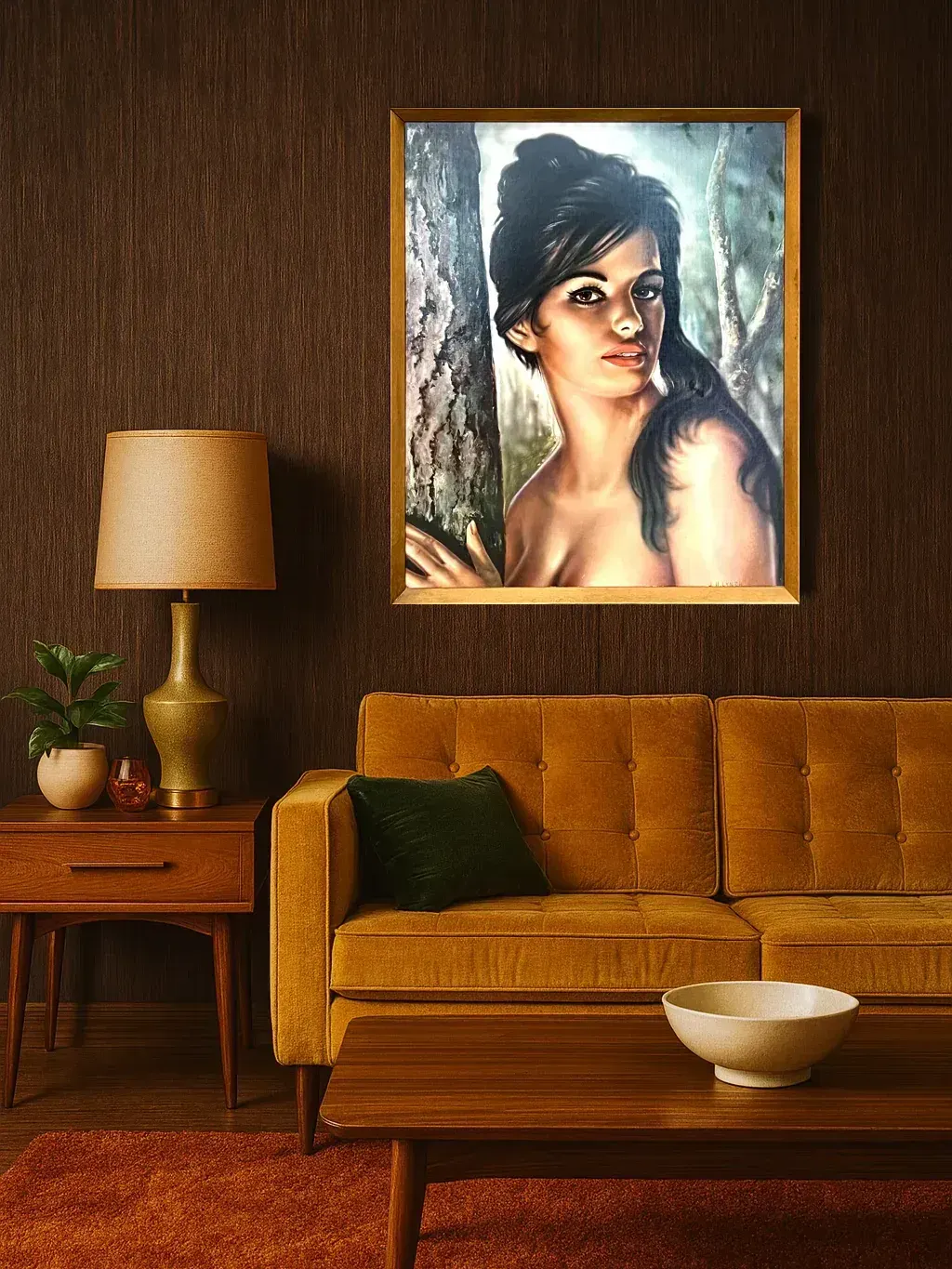
Tina was not of flesh and bone. She had no pulse. She adorned the living room wall of Number 19 for my entire childhood and teenage years. Created by little-known artist J H Lynch and mass-produced for stores like Boots and Woolworths, Tina was classified as mid-century kitsch art. This does not do her justice.
Her face was serene and all-knowing. She saw everything. I stared at her until I felt I was merging into the picture, and sometimes she seemed to beckon me to follow her into the safety and calm of the woodland beyond. She watched over me like a guardian angel.
When mid-century furniture came back in vogue, Tina reappeared in my life as a reproduction printed on canvas. I had it mailed from the UK, framed her and hung her proudly on my wall. My home was complete. Visitors were mystified and bemused. I was ecstatic.
Early in 2025, my daughter Tess who now lives in London, spotted a Tina original in a retro store on a weekend visit to Manchester. She gave me the details, I called the store, paid over the phone and they bubble-wrapped the life out of her before she was collected and taken back to London. That summer, Tess lovingly handed Tina to me, aware of her significance. A short time later I arrived at Heathrow for my return to Sydney and excitedly carried her onto the plane as precious cargo, fragile stickers slapped all over her. An original Tina.
That woman in the woodland, in her own quiet way, helped raise me too. For me, Tina belongs alongside the women of Botticelli, Rubens and Modigliani.
What the village gave me
I didn’t have one mother. I had many. Christine, who held the door open without a word. My gran, who sat with me in the firelight and fed me and gave me quiet. Mrs Ballantyne, who showed me that a woman could set herself free with enough determination. My auntie blew away the notion of “station” and showed me I could be more. The intuitive and creative thinking Miss Clay, who wrote the letter and opened my world to art. From another village, Jill’s mum who was brimming with homeliness and kindness. Bridget’s mum Ann, who I still visit every time I go back to England – and is one of the most tolerant, kind-hearted and good-humoured human beings I know. And Tina, who never spoke a word, never moved from her woodland, and yet watched over me for an entire childhood.
None of them made speeches. None of them sat me down and told me I was worth something. That wasn’t how it worked. It was the open back door and the kettle already on. The coal fire and the quiet. The smell of nutmeg and the William Morris wallpaper. The weekends at my auntie’s house. The letter.
It was presence. It was the steady, unremarked accumulation of being somewhere you were welcome, with people who didn’t flinch at what you came from. I absorbed all of it, all those years, without knowing I was doing it. Without knowing it was building something in me that the chaos at Number 19 could not touch.
If I didn’t have those people, I don’t know where I’d be. I know I probably wouldn’t be here, writing this. It takes a village. Mine happened to be full of extraordinary women who never once called themselves that.
New essays arrive by email. No frequency promises, only when there's something worth saying.

Member discussion